




Foods for special medical purposes

F.S.M.P.
Definition and regulations for FSMPs
Regulation (EU) 609/2013 defines them as “a foodstuff specially processed or formulated and intended for the dietary management of patients, including infants, to be used under medical supervision; it is intended for the exclusive or partial feeding of patients with a limited, impaired or disturbed capacity to take, digest, absorb, metabolise or excrete ordinary food or certain nutrients contained therein or metabolites, or with other medically-determined nutritional requirements, whose dietary management cannot be achieved exclusively by modifying the normal diet.”
Characteristics of Foods for Special Medical Purposes
In addition to the Food for Specific Groups (FSG) Regulation, the subsequent Regulation (EU) 2016/128 has already been published, laying down specific requirements for the composition and information of foods for special medical purposes.
FSMPs must comply with the guidelines for foods for special medical purposes and must be notified to the Ministry of Health before being placed on the market.
What distinguishes an FSMP from other foods is its ability to meet, wholly or in part, the specific nutritional requirements arising from a disease, disorder or medical condition (and any resulting malnutrition), or otherwise to support dietary management of the condition.
The formulation of FSMPs can vary considerably depending on whether they are nutritionally complete or incomplete, as well as on the recipients’ medical condition and age and the setting in which healthcare is provided. Another key requirement for a product to qualify as an FSMP is that its use must genuinely be subject to medical supervision in order to achieve the expected benefits. A product can only qualify as an FSMP if the foods already available are insufficient to ensure effective dietary management of a particular disorder or disease. For the reasons outlined above, ordinary food supplements cannot be marketed as FSMPs.
Source: Unione italiana food
The Importance of FSMPs in Clinical Nutrition
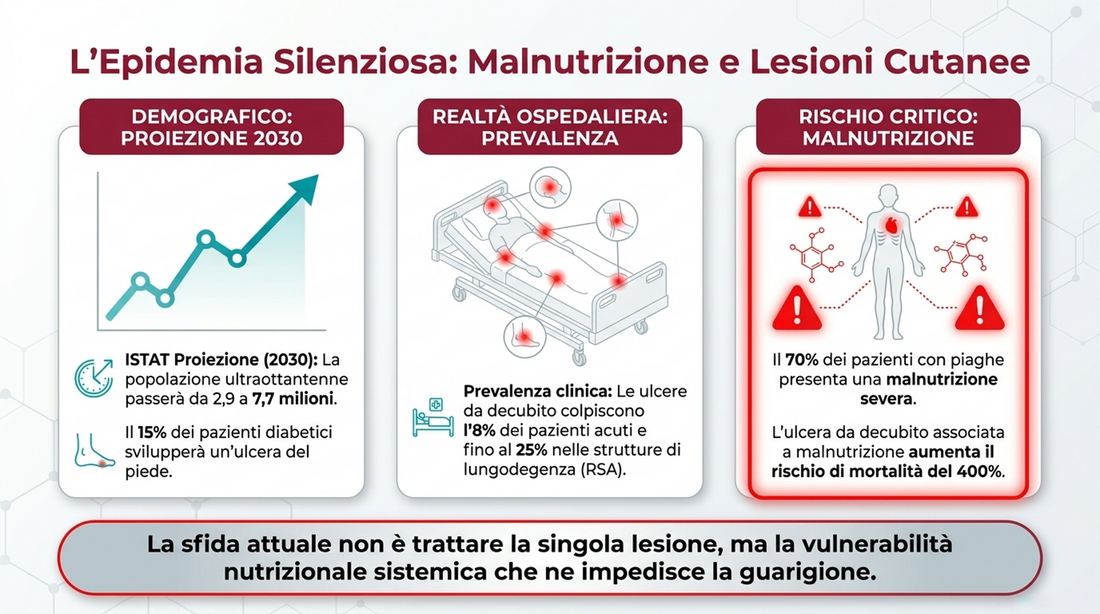
Both undernutrition and overnutrition affect a large number of patients, increasing the risk of mortality by 2.6 times and the likelihood of complications by 3 times, as well as extending hospital stays by 30%, thereby increasing hospital treatment costs. It is estimated that 33 million people in Europe are at risk of malnutrition, at a social cost of around €120 billion.
In recent years, malnutrition has been addressed by doctors, healthcare professionals, institutions, patients, industry and the media, highlighting the vital role of supplementation with products classified as Foods for Special Medical Purposes. These foods, given to patients with various conditions, have improved patients’ clinical status, quality of life and tolerance of treatment. They may be available as liquids, creams or powders for people who can still eat normally by mouth. Health economics studies have shown that identifying and appropriately treating malnutrition reduces healthcare costs. One example illustrates this: in cancer surgery, even when using the most expensive formulas containing immunonutrients, savings of €1,250 per patient can be achieved by reducing complications and length of hospital stay.


